




BMI Calculator (Body Mass Index) – Free & Accurate

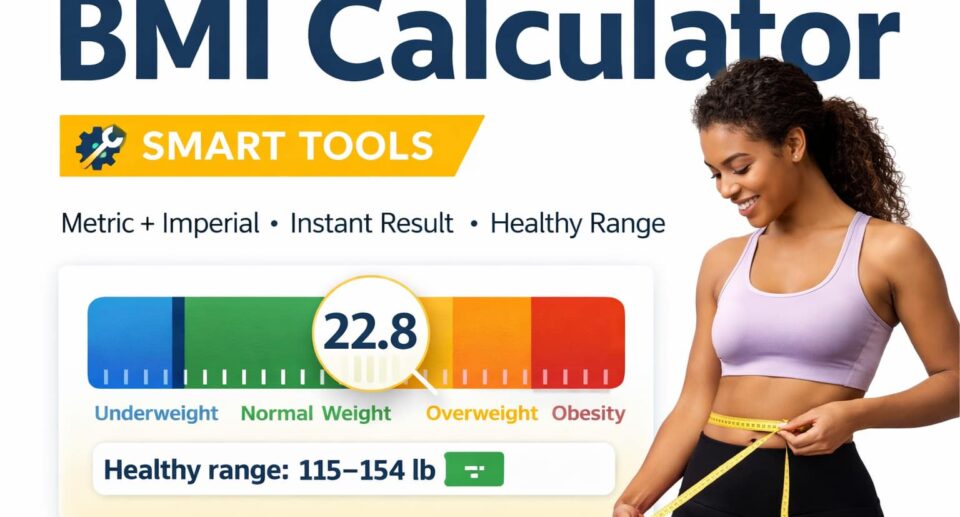
Use our BMI Calculator to quickly determine your Body Mass Index (BMI) and understand whether your weight falls within a healthy range. This tool works with metric (cm/kg) and imperial (ft/in/lb) units and provides instant results along with helpful guidance.
Trusted & Simple: Uses the standard BMI formula (kg/m²) commonly used by health professionals for adults.
Table of Contents
ToggleCalculate Your BMI
Choose a unit system, enter your measurements, and get your BMI instantly.
—
Disclaimer: This calculator is for informational purposes only and does not replace medical advice.
What Does Your BMI Result Mean?
Body Mass Index (BMI) is a numerical value derived from your height and weight. It helps categorize body weight and is widely used as a screening tool to assess potential health risks related to weight.
BMI can help you:
Understand whether your weight is within a healthy range
Identify possible weight-related health risks
Set realistic fitness and nutrition goals
BMI does not directly measure body fat, but it offers a quick, standardized estimate.
BMI Categories Explained
| BMI Range | Weight Category |
|---|---|
| Below 18.5 | Underweight |
| 18.5 – 24.9 | Normal Weight |
| 25.0 – 29.9 | Overweight |
| 30.0 and above | Obesity |
If your BMI falls outside the normal range, gradual lifestyle changes can significantly improve overall health.
Healthy Weight Range by BMI
A healthy BMI range is typically 18.5–24.9 for most adults.
Your calculator result also shows a healthy weight range for your specific height. This is often more useful than BMI alone because it gives you a practical target range instead of a single number.
How Is BMI Calculated?
The standard BMI formula is:
BMI = weight (kg) ÷ height² (m²)
For imperial units, the formula is adjusted using a conversion factor.
This calculation method is recognized by organizations such as the World Health Organization (WHO) and Centers for Disease Control and Prevention (CDC).
Limitations of BMI
Although BMI is widely used, it has some important limitations:
It does not measure body fat percentage
Muscular individuals may have a high BMI despite low body fat
It does not account for age, sex, or fat distribution
It may not be suitable for athletes, pregnant women, or the elderly
For this reason, BMI should be used as a general guide, not a diagnosis.
BMI vs Body Fat & Muscle
BMI cannot distinguish between fat mass and lean muscle.
For example:
Athletes may appear “overweight” by BMI standards
Someone with normal BMI may still have high body fat
Additional measurements such as waist circumference, body fat percentage, or waist-to-height ratio can provide better insight into body composition.
How to Improve Your BMI Naturally
If your BMI is outside the healthy range, focus on sustainable habits:
Regular physical activity: strength + cardio workouts
Balanced nutrition: whole foods, adequate protein, fiber
Sleep & stress management: essential for hormone balance
Consistency: small changes over time matter most
Frequently Asked Questions (FAQ)
Is BMI accurate for everyone?
BMI is a useful screening tool for most adults, but it may not be accurate for athletes, older adults, or individuals with high muscle mass.
What is a healthy BMI?
A BMI between 18.5 and 24.9 is generally considered healthy for adults.
Can BMI tell me how much fat I have?
No. BMI does not measure body fat percentage—it only uses height and weight.
Should children use BMI?
Children and teens require BMI-for-age percentiles, not the standard adult BMI scale.
Can I use BMI to lose weight?
BMI can help set a general goal, but calorie needs, activity level, and body composition should also be considered.
Helpful Resources
Important Disclaimer
This BMI Calculator is for informational purposes only and does not replace professional medical advice.
Always consult a qualified healthcare provider for personalized health recommendations.
Why CoreWellFit’s BMI Tool Is Different
Metric + Imperial support
Instant category & healthy range
Beginner-friendly explanations
Connected to Smart Tools ecosystem
Next Step
Want to go further?
Track your daily calorie needs
Explore fat-loss or muscle-gain planning
Use multiple tools together for better accuracy
👉 Try our Calorie Needs (TDEE) Calculator next.

MD Khairul Islam Shuvo
MD Khairul Islam Shuvo is a fitness product reviewer and research contributor at CoreWellFit, specializing in the evaluation of home workout equipment and consumer wellness tools. He focuses on practical performance, product reliability, and value-based comparisons to help readers make confident, well-informed purchasing decisions.