




The Long Term Tech Life Balance Plan: Sustainable Habits for a Healthier Digital Life

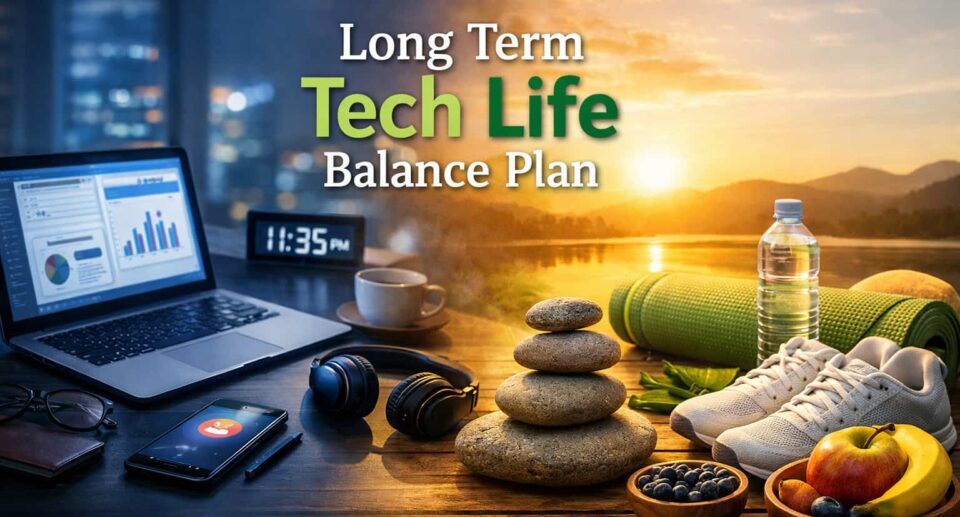
In my previous post,“Mindful Social Media: How to Unfollow Negativity and Curate Positivity”, we learned how to create a positive and healthy digital environment by staying away from negative content. In that vein, today I will talk about the Long Term Tech Life Balance Plan that will help you build a healthy, conscious and balanced digital life not just for the short term, but in the long term.
In today’s fast-paced digital age, we depend on technology for everything from work to communication to entertainment. But excessive screen time, checking notifications all the time, and the habit of being immersed in social media are hurting our mental health. As a result, stress is increasing, attention is decreasing, and the natural rhythm of sleep is being disrupted. So what is needed most now is a sustainable and realistic Tech Life Balance Plan, which we can follow for a long time.
In this article, you will learn how to create a healthier digital life by developing sustainable digital habits where technology will be your helper, not your controller. Let’s make a realistic and effective Long Term Tech Life Balance Plan step by step.
How a Long Term Tech Life Balance Plan Can Transform Your Daily Life
The Science of Distraction
Dr. Anna Lembke, a psychiatrist and professor at Stanford School of Medicine, warns that smartphones have become “digital hypodermic needles injecting dopamine 24/7,” creating a generation dependent on artificial pleasure.(1)
When our brain receives new information or ‘reward’ (such as a like or message), the neurotransmitter Dopamine is released from the Ventral Tegmental Area (VTA) of the brain. When we look at our mobile phone excessively at night, the blue light emitted from it reduces our melatonin hormone content, which results in delayed sleep at night and fatigue during the day. This fatigue hinders our academic activities.
- It gives us temporary pleasure.
- The problem is, the brain wants to get this pleasure repeatedly. As a result, we check our phones repeatedly, which is called “Reward-seeking behaviour”.
Intermittent Reinforcement
Psychologist B.F. Skinner has shown that people or animals are more addicted to something when the time of receiving the reward is not certain.
Checking the phone does not always get something good, but the uncertainty of “maybe I will get something good this time” increases our addiction. It works much like a slot machine in a casino.
Pre-frontal Cortex vs Amygdala
Pre-frontal Cortex: This is the part of our brain that helps in rational thinking and goal setting.
Amygdala: This controls our immediate emotions and reflexes. Excessive digital stimulation tyres our prefrontal cortex, resulting in our ‘self-control’ decreasing, and we continue to scroll on our phones subconsciously, guided by the amygdala.
Signs You Need a Tech-Life Balance Plan

If the following signs are regularly seen in your life, then you need a Long Term Tech Life Balance Plan right now.
Checking your phone repeatedly: This thing has become a phobia for us. Checking your phone now and then is a sign of a new message or a new notification.
Feeling uncomfortable and annoyed without a screen: Feeling restless, bored, and empty.
This is a major sign of digital dependency, which destroys mental balance.
Checking your phone before going to bed and after waking up
- Scrolling before going to bed
- Social media while lying in bed
- Checking notifications after waking up
This reduces the melatonin hormone, resulting in:
- Sleep quality is impaired
- Insomnia
- Morning fatigue
Decreased focus and productivity at work
What are you noticing:
- Simple tasks take longer
- Can’t maintain attention
- Repeatedly checking your phone in the middle of work
Excessive screen time destroys deep focus, which has a big impact on career and performance.
Eye irritation, headaches and physical fatigue
Prolonged screen use causes:
- Eye pain
- Headache
- Neck and shoulder pain
- Physical weakness
These are the main symptoms of digital fatigue.
Feeling down after using social media
If after scrolling:
- Feeling small
- Inferiority
- Depression
- Anxiety increases
Understand that your digital environment has become toxic and is damaging your mental health.
Disengagement from family and real-life relationships
- Decreased time with family
- Decreased contact with friends
- Decreased enjoyment of real-life experiences
Excessive technology use weakens real-life connections, which increases loneliness in the long run.
The Long Term Tech Life Balance Framework
The Long Term Tech Life Balance Framework should be designed so that it becomes a long-term lifestyle rather than just a one-day rule. Here is a framework that can be used in the article:
The 4-P Framework for Digital Harmony
To maintain long-term tech-life balance, we can follow this 4-P Framework:
1. Purpose
Before reducing screen time, you need to know why you are doing it.
The “Wait 30” Rule: Don’t look at any screen for the first 30 minutes after waking up. Use this time to set your goal.
2. Proximity
Your environment controls your habits.
Out of Sight, Out of Mind: When doing deep work, keep your phone in another room or at least out of reach.
Analogue Alternatives: Use a wristwatch to check the time and a table clock for your alarm. This will reduce your dependence on your phone.
3. Partitioning
Clearly divide your digital and analogue life.
Device-Free Zones: Declare the dining table and bathroom as “no-tech zones”.
4. Pruning
Just as you prune a tree for good growth, so too does your digital life.
Notification Audit: Check your app list once a week. Delete apps that haven’t been useful to you in the last 7 days or have caused annoyance.
Unsubscribe Habit: Unsubscribe from unnecessary emails or newsletters that occupy both your inbox and your brain.
Physical Health vs Digital Life
When we stare at a screen, our body becomes fixed in a certain ‘Posture’ or posture. In the long run, this not only causes fatigue but also causes chronic physical problems.
‘Text Neck’ Syndrome and Spinal Protection
When we bend our heads to use our phones, an additional 50-60 pounds of weight falls on our necks (which is equal to the weight of an 8-year-old child).
Solution: Try to keep your phone at eye level while using it. Do light neck stretching exercises every 30 minutes.
Digital Eye Strain
When staring at a screen for a long time, your eyes blink less, which can dry out your eyes and cause blurred vision.
Blue-light and Sleep Cycle (Circadian Rhythm)
Artificial blue light emitted from screens reduces our brain’s production of Melatonin (the sleep hormone).
Result: Insomnia and reluctance to work the next morning.
Tips: Turn on ‘Night Mode’ at least 1 hour before bed or put your phone away completely.
Sedentary Lifestyle or Harmful Side Effects of Sitting
The use of technology has reduced our mobility. Sitting and scrolling for long periods increases the risk of heart disease and obesity.
Mental Well-being

Although technology connects us, it is strangely increasing our loneliness and stress. To reduce this digital pressure on the mind, it is important to understand the following points:
Social Media and ‘FOMO’ (Fear Of Missing Out)
We compare our real lives by seeing perfect pictures or success stories of others. This is called “Social Comparison”. As a result, ‘FOMO’ or fear of missing out works in our minds.
Remedy: Remember, social media is just a “Highlight Reel” or collection of the best moments of people’s lives. This is not entirely true.
Information Overload and Digital Fatigue
The mountain of news feeds, notifications and information all day long makes our brain tired (Decision Fatigue). When the brain cannot process a lot of information at once, anxiety or worry is created.
Solution: Observe “Silent Hour” at least twice a day, where you do not take any input (such as news or video).
Digital Mindfulness
We often get “lost” in our phones. We may have checked the time, but 15 minutes later we find ourselves scrolling through Facebook Reels.
Tip: While using your phone, take a conscious breath and notice how you are feeling right now. This is called mindfulness.
FAQ
Q: What is a Long Term Tech Life Balance Plan?
A long term tech life balance plan is a sustainable approach to managing technology use in a healthy way. It focuses on building mindful digital habits, setting boundaries, and creating routines that reduce screen dependency, improve focus, and support mental and physical wellbeing over time.
Q: How can I start building a sustainable tech-life balance?
You can start by tracking your daily screen time, setting clear digital boundaries, creating tech-free zones at home, practicing regular digital detox routines, and replacing excessive screen use with healthy offline activities like exercise, reading, or family time.
Q: Why is long term tech life balance important for mental health?
Long term tech life balance helps reduce stress, anxiety, digital fatigue, and sleep problems caused by excessive screen use. By maintaining healthy digital habits, you can improve concentration, emotional wellbeing, productivity, and overall quality of life.
A few words from CoreWellFit
The Long Term Tech Life Balance Plan is not a temporary digital detox-it’s a sustainable lifestyle change that helps you gradually build a healthy, mindful, and balanced digital life. Eliminating technology is not possible, nor is it necessary. Rather, using it correctly and mindfully is the real solution.
Start building small habits today-controlling screen time, setting digital boundaries, creating tech-free time, and prioritizing mental peace. Remember, lasting change comes with patience and consistent practice. These small daily decisions will positively change your mental health, productivity, and quality of life in the long run.
Ultimately, the Long Term Tech Life Balance Plan will lead you to a life where technology is in control of you, not you in it. Start your journey today on the path to a calm, focused, and healthy digital life.